poniedziałek, 25 lutego 2019

Copernicus as an economist- "On the Minting of Coin"


A drawing by Johan Schübeler from the second half of the nineteenth century, depicting Nicolaus Copernicus presenting his treaty De monetae
Copernicus’ achievements in the field of economics were equally significant as his achievements in astronomy. He wrote three versions of his essay about money and economy „On the Minting of Coin”. The first version of the essay was written in 1517, the second in 1519 and the third one in 1521. In the essay Copernicus mentioned the law of bad money driving out good money. It states that inferior money (made of worse metal and of lesser value,) displaces money better from circulation (made of better and of greater value). The principles were decades later repeated by the English financier Thomas Gresham and are known in economy as Greshams or Copernicus-Greshams Law. What is more, Copernicus was one of the first advocates of modern monetary policy based on the unification of the currency in circulation, constant care for its value and the prevention of inflation, which ruins the economy. Additionally, Copernicus was not only a theorist of finance, but he was also the co-author of a successful monetary reform. 


Copernicus defined different functions of money:
  • a measure of value,
  • a necessary medium of exchange (for payment or purchase)
  • a necessary medium of savings.
A collector coin with Copernicus holding his essay about money


Author: Błażej Jóźwik, 2F
Supervisor: Emilia Woźniak

czwartek, 21 lutego 2019

Not only an astronomer and economist...


There is no denying that Nicolaus Copernicus is famous for his heliocentric theory of the universe. However, he was not only an astronomer. Copernicus was a real man of the Renaissance so he was talented in more than one field.


Did you know that Copernicus was also a translator? He translated the Letters of Theophylactus from Greek to Latin. This letter-writing Theophylactus was later surnamed Simocatta in order to distinguish him from several other Greek authors also called Theophylactus. Copernicus may have decided to translate The Letters to improve his Greek. He dedicated the translation to his uncle Lucas Watzenrode. It was published in Kraków in 1509 by Johann Haller. It was the only book that Copernicus ever brought out on his own account.


The first pages Theophylactus Simocattes’s Letters translated by Copernicus, published in Cracow in 1509


Copernicus as a cartographer: Copernicus made some maps of his homeland himself. His first independent work was of Warmia and the western borders of Royal Prussia. The map was valuable also for the Tautonic Order, because they wanted 
to use the map to reclaim the territory lost in 1466. Before the important assembly the Order sent their spy who searched Copernicus quarters trying to secretly steal the map to hand it over to the Order. The spy didn't find the map. It is also known that in July 1529, Nicolaus Copernicus and his good friend, produced a map of the whole of Prussia. Unfortunately, its fate is unknown and it must have become lost.


Nicolaus Copernicus was also a canon and a soldier. He was a great opponent of The Tautonic Order.  In 1516-1521 Copernicus administered the Warmian Chapter’s property, including its nearby lands and the castle in Olsztyn. He was a canon, however, he was not a priest because he was never ordained. During Copernicus' administration of the Olsztyn Castle, another war with the Teutonic Order broke out. In 1520, Copernicus with few armed men defended the castle in Olsztyn against the enemy. He made solid preparations to fend off the attack. In fact he was so successful that after just one attempt, the enemy withdrew from its plan to conquer the castle.


The Castle in Olsztyn

       In addition, Copernicus was a respectable doctor. He studied medicine in Padua, in Italy. He was the personal "medicus" and secretary of his uncle, Bishop Lucas Watzenrode. After the death of his uncle in 1512, Copernicus became the personal physician to 4 other bishops. 
What is more, Copernicus helped and supported poor people. He not only diagnosed and took care of his patients but also personally prepared the prescribed drugs. During the epidemics of 1519, Copernicus implemented sanitary and counterepidemic measures. He installed an innovative water supply system in several Warmian and Pomeranian towns.  
        In many portraits of Copernicus, he is depicted holding a lily of the valley in his hands. The flower was a Renaissance symbol of the medical profession.


Copernicus with lily of  the valley in his hands


wtorek, 19 lutego 2019

Inspired by Copernicus


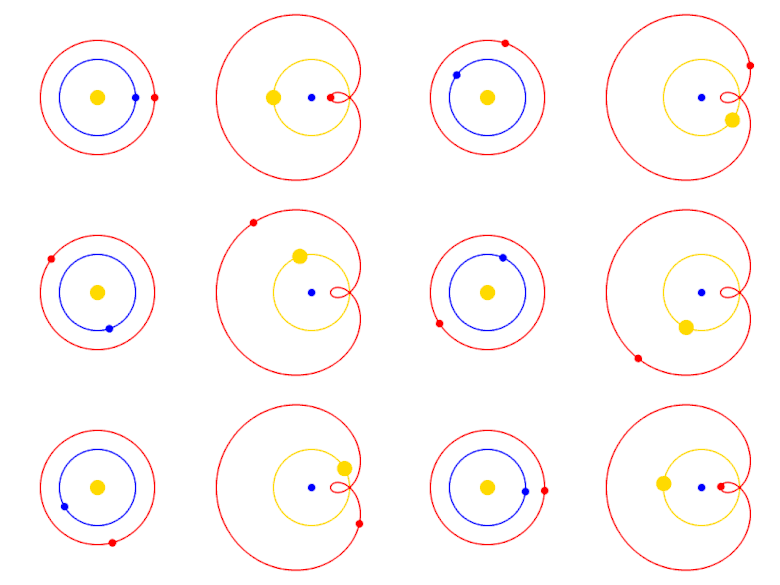
The publication of Copernicus’ De revolutionibus orbium coelestium started a ”Copernican Revolution.” It was a paradigm shift from the Ptolemaic model of the heavens, which described the cosmos as having Earth stationary at the center of the universe, to the heliocentric model with the Sun at the center of the Solar System. The helicoentic theory inspired many scholars who contributed to the Copernicus’ model of the universe.


Motion of Sun (yellow), Earth (blue), and Mars (red) according to heliocentrism (left) and to geocentrism (right), before the Copernican Revolution.

An  Italian monk Giordano Bruno was a great supporter of Copernicus’ ideas. He is known for his cosmological theories, which conceptually extended the then-novel Copernican model. He proposed that the stars were distant suns surrounded by their own planets. He also insisted that the universe is infinite and could have no "center". Bruno was tried for heresy by the Roman Inquisition. The Inquisition found him guilty, and he was burned at the stake in Rome's Campo de' Fiori in 1600. Giordano Bruno has been considered to be a martyr for science since 19th century. 


A Danish nobleman and astronomer Tycho Brache admired Copernicus’ work especially for his mathematical solutions. Although Tycho appreciated the advantages of Copernicus's system, he could not accept the movement of the Earth and settled on geoheliocentrism, meaning the Sun moved around the Earth while the planets orbited the Sun. The King of Denmark gave Tycho Brahe an Island Hven, where he established an observatory called Uraniborg. When Tycho died unexpectedly his assistant Johann Kepler continued his work.


Johannes Kepler was a great supporter of Copernicus’ ideas. In his first book The Mysterium Cosmographicum he openly endorsed Copernican cosmology.  Kepler like Copernicus, asserted the physical reality of a heliocentric model as opposed to a geocentric one. Yet, despite all of his breakthroughs, Kepler could not explain the physics that would keep a planet in its elliptical orbit. He was also the author of Kepler's Laws, describing the motion of planets around the Sun. You should remember the laws from your physics lessons at school. 😃


Galileo Galilei was an Italian scientist who is sometimes referred to as the "father of modern observational astronomy". Galileo Galilei came after Kepler and developed his own telescope. It allowed him to study Venus and discover that it has phases like a moon. The discovery of the phases of Venus was one of the more influential reasons for the transition from geocentrism to heliocentrism. The idea of a heliocentric solar system was so controversial that the Catholic Church classified it as a heresy, and warned the Italian astronomer Galileo Galilei to abandon it. The Inquisition forced Galileo to say he was wrong— that the Earth did not revolve around the sun. Galileo had made the proclamation in his book Dialogue Concerning the Two Chief World Systems. Legend has it that after he recanted his views, Galileo muttered, “And yet it moves,” under his breath. However, there’s no historical basis for that claim.


Isaac Newton was a well known English physicist and mathematician. He was a main figure in the Scientific Revolution for his laws of motion and universal gravitation. The laws of Newton are said to be the ending point of the Copernican Revolution. Newton was eventually able to show that gravity was responsible for the orbital motions of all of the planets in the solar system, prompting him to name it "universal gravitation". By applying his theories regarding gravitational forces, Newton was able to derive Keppler's three laws of planetary motion mathematically, removing any lingering doubts about the validity of a heliocentric model of the solar system.

Hello everyone!

     
        Nazywam się Emilia Woźniak. Jestem nauczycielem języka angielskiego w ZSP nr 2 w Siedlcach. Założyłam ten blog, żeby pomóc uczniom w przygotowaniu się do konkursu wiedzy o patronie szkoły- Mikołaju Koperniku. Na blogu, wspólnie z chętnymi uczniami będziemy zamieszczać posty z najważniejszymi informacjami na temat życia i działalności słynnego astronoma. Mam nadzieję, że opublikowane treści okażą się przydatne. Wierzę, że temat okaże się dla Was tak samo ciekawy jak dla nas. Życzę Wam wytrwałości w zgłębianiu wiedzy na temat Mikołaja Kopernika oraz powodzenia na konkursie! :)


Commemoration

To commemorate the great astronomer his name was given to many institutions, places and things. Below you will find some examples of the...